



RESULTS AND IMPACT
Promoting Environmental Awareness Through Smart Scanning
Lack of Modern Technologies for Waste Management
CONTEXT
THE PROBLEM
The Design Approach
The Design Process
Typography, Color and Logo
Simple. Modern. Straightforward.
What I Learned Along the Way
OBJECTIVES
PROJECT FLOW
DESIGN CHOICES
FINAL DESIGN
PROJECT TAKEAWAYS
STARTING PAGE AND ONBOARDING
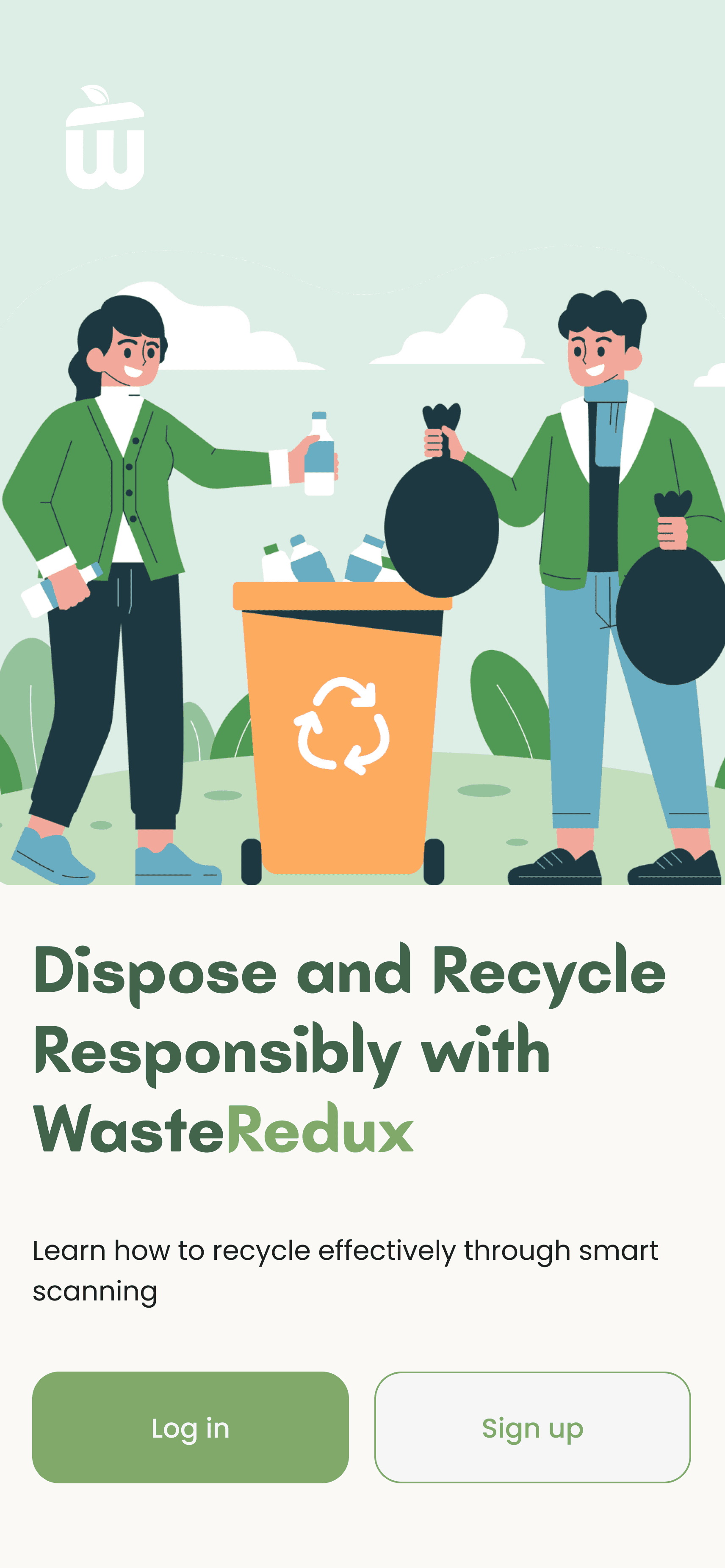
This is the onboarding process of WasteRedux, designed to guide users through the key steps of using the app—from scanning waste to learning proper recycling and disposal methods.
HOME PAGE, SCAN HISTORY AND ARTICLES PAGE
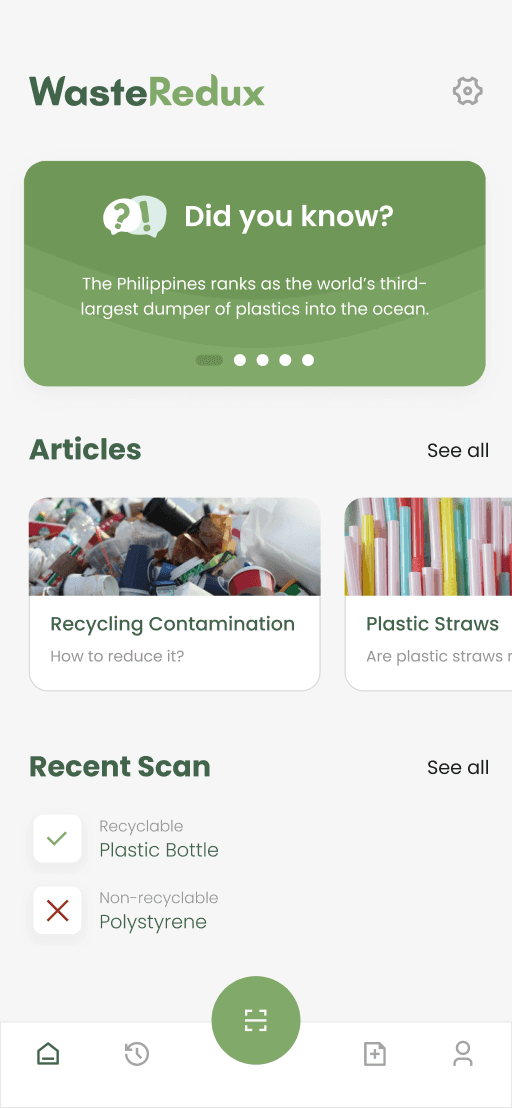
The Home page contains educational tools such as trivia and articles that users may utilize to expand their environmental awareness. Users can also fully view articles and their recently scanned waste materials in a scan history.
SCANNER FEATURE
SOLID WASTE ANALYSIS RESULTS
REGISTER WASTE AND PROFILE PAGE


The scanner feature lets users scan solid waste by taking a picture. It can currently identify three types of materials: plastic, metal, and glass.
If the material scanned is recyclable, it will provide the user with a step-by-step procedure for proper waste recycling methods. Otherwise, it will just provide proper disposal of the waste material.
Users can register unrecognized waste by uploading an image and its details, allowing the app to enhance its classification accuracy.
AI is a Powerful Design Partner: Working on WasteRedux showed me how artificial intelligence play a major role in shaping the future of digital solutions, especially in solving real-world environmental challenges
Technology Can Drive Environmental Awareness: I learned that integration of technology, even in small actions like scanning waste, can spark behavior change and promote sustainability at scale.
Ideation
Brainstorming of content, user flows, skteching and wireframing
Visual Design
Creating design system and turning sketches into interactive prototypes
Testing
Design and usability testing, final review and project hand-off
Research
Gathering insights, defining problems and objectives
WasteRedux is more than just a solid waste classification app—it’s a move toward more responsible and sustainable waste habits. By combining image recognition technology with educational content, WasteRedux not only identifies different types of solid waste but also informs users about the proper methods of recycling and disposal. It turns everyday habits into opportunities for learning and impact.
Improper waste management in the Philippines leads to environmental harm, health risks, and poor recycling. Despite ongoing efforts, there's a lack of accessible, tech-driven solutions especially for students and communities. Most initiatives rely on manual methods, overlooking modern tools like Convolutional Neural Networks (CNNs) to automate and enhance waste classification and management.
The WasteRedux design system reflects the app’s environmental advocacy through its logo, colors, and typography. The logo, shaped like a “W,” represents a trash bin and symbolizes responsible waste management,. This reflects the app’s mission to help users properly identify, recycle, and dispose of solid waste.
The color palette uses green tones which represents nature and sustainability. For typography, Batangas provides a bold, approachable tone, with curved corners subtly resembling a leaf to reflect the app’s identity, while Poppins is used for readability in UI elements, ensuring a clean and modern look.
This project was developed during my final year in college. It was made possible through the integration of Convolutional Neural Networks (CNN), which a type of artificial intelligence that helps computers understand images—kind of like how our brains process what we see.
Clear Application Instructions: Ensure that the onboarding and in-app guidance are clear and simple to ensure that users can easily navigate scanning and other features even on their first use.
Design for Awareness: Integrate learning materials into the app (e.g., recycling tips, fun facts, or trivia) to raise awareness while performing everyday actions.
User Contribution: Allow users to register unknown solid waste material allowing them to participate in improving the tool.
Design an app that utilizes image recognition technology, such as Convolutional Neural Networks (CNN) to assist individuals in accurately identifying solid waste while promoting proper disposal, recycling, and environmental awareness
While the application achieved 60% accuracy in waste type classification and 73% in recyclability detection, it successfully demonstrates the potential of AI in environmental education. It also aligns with Bulacan State University’s “Dark Green School” initiative and, with further improvement, has the capacity to create scalable impact in sustainability efforts.
KEY CHALLENGE

WasteRedux Application
Type School Project
Role UI/UX Designer
Date Jan - Nov 2024
Tools


RGB: 129 169 105
HEX: #81A969
RGB: 65 100 74
HEX: #41644A
RGB: 221 238 231
HEX: #DDEEE7
RGB: 246 246 246
HEX: #F6F6F6
Poppins Semi Bold
Poppins Regular